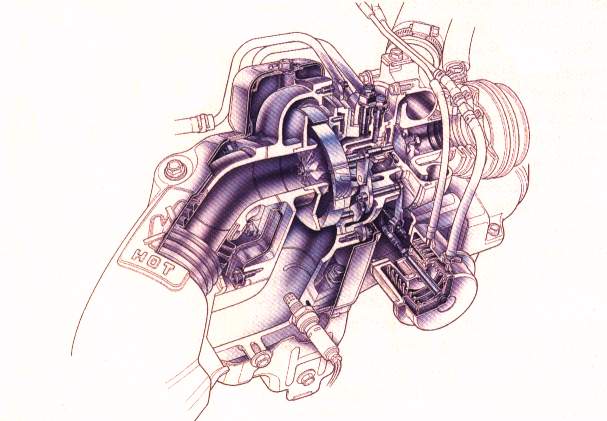
Honda Legend "wing turbo"
Kategoriregler
Bilder och filmer från träffar lägger du under eftersnackskategorin, ej här.
Bilder och filmer från träffar lägger du under eftersnackskategorin, ej här.
-
TriXiE77
- Inlägg: 867
- Blev medlem: 13 juni 2004, 13:54
- Bil: Bilbytarkungen
- Namn: Mikael Fröjdfeldt
- Ort: Eskilstuna / Västerås / Stockholm
Satt och slösurfa runt lite och snubblade över den här modellen på legend:

Saxat från wiki
http://en.wikipedia.org/wiki/Honda_Legend
"""Wing Turbo" version
In 1989, Honda upgraded the C20A V6 engine used exclusively in the KA5 series Legend with a variable geometry turbocharger calling it the "Wing Turbo" Japanese TV commercial to address the modest power available from the previous engine with variable length intake manifold used in earlier models. The turbocharger compressor housing had four vanes made from heat resistant Inconel alloy surrounding the turbine wheel on the air intake side that would fluctuate based on engine load and transmission gearing above 2,000 rpm to allow for increased airflow into the engine as needed. The turbo compressor could generate as much as 450 millimetres of mercury (8.7 psi) of boost, and was paired with a water cooled intercooler installed inside the intake plenum between the cylinder banks to produce 140 kW (190 PS; 188 bhp) net at 6000 rpm and a maximum torque of 24.6 kg·m (241 N·m; 178 lb·ft) at 3500 rpm.[4] Honda Legend V6 turbo idling
According to an excerpt originally printed by Automotive Engineering dated January 1989 "The movable wings are positive pressure- and vacuum-operated, their angle changes are controlled by an eight-bit 36-kilo byte computer that also manages fuel injection. Positive pressure to the wing actuator is supplied by the turbo's supercharge pressure, controlled by a frequency solenoid valve, and negative pressure is generated by intake vacuum and accumulated in a reservoir which is also solenoid controlled. The CPU is fed signals including boost pressure, intake temperature, coolant temperature, throttle opening, engine rpm, and vehicle speed. The Wing Turbo is not fitted with a conventional wastegate.
On idling and steady-state cruising that do not require supercharging, the movable flags--or wings--which are fully opened, allow exhaust gas to enter the enlarged nozzle area and pass through the turbine smoothly with little resistance. At the beginning of full acceleration, the wings close fully, reducing the nozzle area through which accelerated gas enters and strikes the turbine blades forcefully, gaining boost quickly. When maximum boost is obtained, the movable wings begin to close gradually, until the vehicle reaches a desired cruising velocity whereby the wings open fully. The nozzle area varies continuously according to operating and load conditions."[5]
The turbo was installed just above the automatic transmission unit; a manual transmission was not offered. This engine was only offered in Japan using the shortened sedan bodystyle, labeled as "2.0 Ti Exclusive" and "2.0 Ti". The engine was used for just one year, due to the introduction of the second generation Legend in 1990 with the much larger C32A V6, and as such Wing Turbo sedans are extremely rare. Much of the research on this engine contributed to the VTEC C30A V6 engine used in the 1990 Honda NSX. The Legend Turbo can be identified as sharing the front grille with the all new 1990 Honda Ascot with a "turbo" badge attached to the grille on the bottom right hand side.""
Någon som kört eller sett nån i Sverige?
Såldes tydligen bara under 2år i Japan. Too bad.
073-9034221
Medlemnr: 595
The "trixiewatch" - no of hondas owned: 80
The "malcolmbattle" - EF:16 EG:21 Delsol:9 EK:9 EP:7
__________________________________________________
TRIXIE RACING
Medlemnr: 595
The "trixiewatch" - no of hondas owned: 80
The "malcolmbattle" - EF:16 EG:21 Delsol:9 EK:9 EP:7
__________________________________________________
TRIXIE RACING